Ιησούς Σινά

Τι πλέον θέλεις;

Εγώ πατήρ, εγώ αδελφός, εγώ νυμφίος, εγώ οικία, εγώ τροφεύς, εγώ ιμάτιον, εγώ ρίζα, εγώ θεμέλιος, παν όπερ αν θέλεις εγώ. Μηδενός εν χρεία καταστείς. Εγώ δουλεύσω.

Ήλθον γαρ διακονήσαι, ου διακονηθήναι. Εγώ και φίλος και ξένος και κεφαλή και αδελφός και αδελφή και μήτηρ. Πάντα εγώ.

Μόνον οικείως έχε προς εμέ. Εγώ πένης δια σέ και αλήτης δια σέ, επι σταυρού δια σέ, άνω υπέρ σου εντυγχάνω τω Πατρί κάτω υπέρ σου πρεσβευτής παραγέγονα παρά του Πατρός.

Πάντα μοι σύ και αδελφός και συγκληρονόμος και φίλος και μέλος.

Τι πλέον θέλεις;

Αγιος Ιωάννης ο Χρυσόστομος

Σάββατο 22 Οκτωβρίου 2011

Το αντίδοτο της λύπης είναι η δοξολογία στον Θεό. πατήρ Παϊσιος

36.jpg


- Όταν , Γέροντα, βλέπω μέσα μου υπολείμματα από εάν πάθος στενοχωριέμαι.


- Πες: «Δόξα σοι ο Θεός, που έφυγαν τα πολλά!». Αν ήμουν εγώ στη θέση σου ,θα έβλεπα τις ολοφάνερες μεγάλες δωρεές του Θεού και «από φυλακής πρωίας μέχρι νυκτός» θα έλεγα το «δόξα σοι ο Θεός».

Αν θέλης να ζης ζωή παραδεισένια από αυτήν την ζωή, δες κι εσύ τις ευεργεσίες και τ...ις πλούσιες δωρεές που σου δίνει ο Θεός και άρχισε το «δόξα σοι ο Θεός». Να δοξάζετε τον Θεό ,γιατί σας βοήθησε και προοδεύσατε έστω και λίγο, είτε επειδή εσείς κοπιάσατε, είτε επειδή σας βοήθησαν οι άλλοι. Όταν ο άνθρωπος λέη «δόξα σοι ο Θεός», βοηθάει ο Θεός ,γιατί η ευγνωμοσύνη με το ταπεινό φρόνημα και με τον φιλότιμο αγώνα τραβάει συνέχεια ουράνιες δυνάμεις και ευλογίες θεϊκές.
- Και όταν, Γέροντα, ξέρω ότι θα ξαναπέσω;
- Δεν ξέρεις από φοβία σκέφτεσαι έτσι. Μην έχετε φοβία μήπως ξανακάνετε το ίδιο σφάλμα, γιατί έτσι κλονίζεται η πίστη σας στον Θεό. Μη τα σκαλίζετε τόσο πολύ. Όταν σας λέη ο λογισμός ότι δεν πρόκειται να διορθωθήτε και διαλύεσθε από την λύπη, χρειάζεται να δώσετε ένα ψεύτικο κουράγιο στον εαυτό σας. «Δόξα σοι ο θεός, να πήτε, σήμερα είμαι καλύτερα από χθες. Δόξα σοι ο Θεός χίλιες φορές ...;».

Αν και φαίνεται ψεύτικο αυτό το κουράγιο, μέσα του όμως κρύβει μια μεγάλη δύναμη, την ελπίδα στον Θεό. Η ελπίδα στον Θεό είναι ο μοχλός που αναποδογυρίζει την απελπισία, ελευθερώνει την ψυχή από την λύπη και το άγχος και τονώνει σιγά-σιγά τις πνευματικές δυνάμεις με την θεία ζωντάνια που δίνει.

γέροντας Παϊσιος

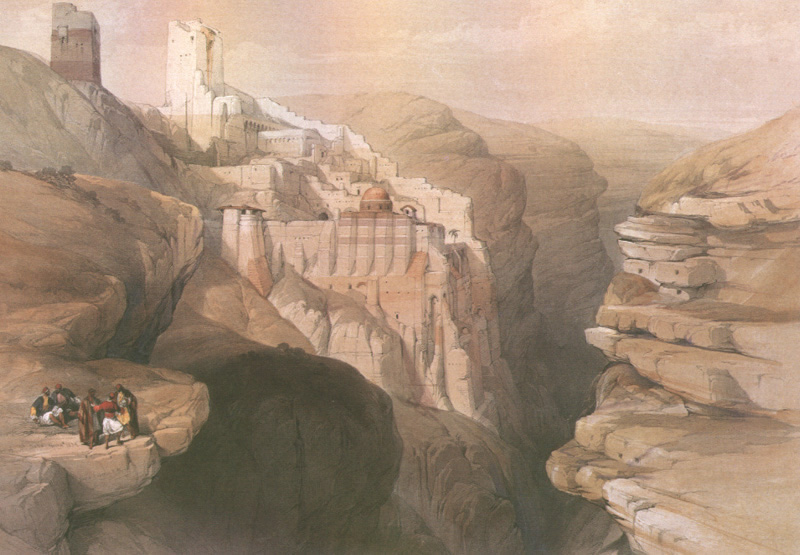
Brief History of the Holy Laura of Saint Sabbas

Brief History of the Holy Laura of Saint Sabbas
1. From the foundation of the Holy Laura to the Arab occupation(483-638 A.D.)
The holy and respected Laura of our Holy Father Sabbas the Sanctified in the Judean desert is a uni­que phenomenon in ecclesiastic history because of its contribution in forming worship and the monastic order and hymnography as well as its multitude of Saints, austere anchorites, divinly inspired theologians and martyrs; Even more significant was the decisive role of the Laura in fighting the heresies which appeared in the Holy Land after its foundation, the defense of Orthodoxy and the rights of the only legitimate Patriarchate of Jerusalem, namely the Greek Orthodox.
The Great Laura of St. Sabbas, now celebrating 1500 years (483-2002) of unceasing monasticism, owes its foundation and development to the God-endowed and Spirit-bearing monk Saint Sabbas (439-532 A.D), who was the lamp4 shining from on high for those wishing to live the life of an anchorite and fervent intercessor before the Lord for all future "Sabbaite" monks. The first nucleus of the Laura was created by seventy hermits who had gathered around St. Sabbas in 483 A.D. Subsequently, the Laura was relocated from the eastern side of the Kidron valley, where the hermitage of St. Sabbas was located, to the western side, where the Theoktistos Church was built (486, consecration 491 A.D). The increased number of the brotherhood members made it necessary to build the main church of the Theotokos (502 A.D) and to organize the Laura buildings and facilities so as to serve the ever increasing needs. St. Sabbas' reputation and holiness, which resulted in his elevation to head and instructor of all the anchorites of the Jerusalem area (493 A.D), influenced even the Great Laura which became the model of monastic life and liturgical order -the Typikon- not only for the other three lauras and six coenobiums which St. Sabbas founded before his death (532 A.D), but also for the other monasteries in Palestine and, during the Middle Ages, the worldwide Church.
Under the leadership of Saint Sabbas, the Great Laura initially undertook the fight against the heresy of Monophysitism from 512 to 516 A.D, confronting emperor Anastasios and the other three Patriarchates of the East, which were in the hands of the Monophysites. The courageous stand and confession of the anchorites saved the Patriarchate of Jerusalem from heresy. St. Sabbas' successors in the abbacy made the Laura a stronghold against the heresy of Origenism; Under the guidance of the Sabbaite St. John the Hesychast, former bishop of Colonia (454-558), the Laura abbots Gelasios (537-546), Kassianos (547-548) and Κοnοn (548-568) overwhelmed the wiles of Origenists and their intrigues before the emperor Justinian, yet not without cost. The monks of the Laura, which was the only monastery supporting Orthodoxy, suffered persecution and acts of violence and eνen the enforced enthronement of the Origenist Abbot Georgios (547 A,D). Neνertheless, God saνed the Laura, and Konon's actions contributed greatly to the summoning of the Fifth Ecumenical Synod (Council) (553 Α.D), which condemned the errors of Origen once and for all and favored the entire Church for eνer. The appearance of the Persians in the Holy Land (614 Α.D) was the prelude of the inνasion of the Arabs of Islam (638 Α.D). The first holy martyrs of the Laura were the forty-four Sabbaite fathers slain by the Persians on 16th May, 614 Α, D.


2. The period during the rule of the Arabs, the Crusades and the Mamluks (638- 1517 A.D.)
The reorganization of the Great Laura under Patriarch Modestos after the Arabian conquest was followed by the glorious period, the "golden age of the Laura, namely the eighth and part of the ninth century A.D. The greatest theologian of the eighth century, Saint John of Damascus, the hymnographer, Kosmas the Hagiopolite, Stephanos the Melodist, Michael the Synkellos, Theodore and Theophanes the Graptoi (Branded), Theodore, bishop of Karron (Abu Qurrah), - distinguished for their holiness and theology, and the Saints Stephanos the miracle-worker, Theodore bishop of Edessa and Michael the holy martyr enriched both the Church of Jerusalem and the Universal Church. Despite the violent and murderous invasions of various barbarians (796, 809, 813 Α.D) and general disorder, the contribution of the Laura to the Church reaches its peak with the stand in favor of the holy icons of Saint John of Damascus during the first period of Iconoclasm (726-787) and that of Saints Michael Syncellos, Theophanes and Theodore the Graptoi (Branded) during the second period of Iconoclasm (814-843 Α.D.). The significant role of the Laura for theology is evidenced by the fact that the last three above mentioned confessors were summoned to Constantinople by St. Theodore the Studite in relation to this subject. Apart from its theological literary production during this period, the Laura increased its copying and translating activities, becoming the center of Georgian literature from the seventh to the tenth century, as well as the center for translation of ecclesiastical writings from Greek into Arabic. Α characteristic example of this is the widely known Ascetic Homilies by St. Isaac the Syrian which were first translated from Syrian into Greek by the monks Αvramios and Patrikios at the end of the 8th century. The liturgical Typikon of the Laura, along with the hymns of the Sabbaite hymnographers and probably certain monastic practices of the Laura, were widely disseminated by distinguished monastery founders from the 9th till the 13th century. The Laura Typikon influenced, to a grater of lesser degree, the monastic Typika written by St. Theodore the Studite (9th cent.), St. Paul the Younger of Mount Latros (11th cent.), St. Lazaros of Mount Galesion (10th-11th cent.), St. Luke of Messina (Sicily 12th cent.), St. Neophytos the Recluse (Cyprus, 12th-13th cent.) and St. Nilos of Tamasia (monastery of Maheras, beginning of 13th cent.). Already in the 9th century the Typikon of the Laura had found its way to far-away Georgia (by Gregory Khandzta in 826 A.D.). Parallel there was also a spreading of the new hymnographic poetic form, the canon, developed mainly by St. John of Damascus and his subsequent "Sabbaite poetic school". The hymnographic production of the Laura was the foundation upon which ecclesiastical worship was shaped in the period after Iconoclasm. The eight tones in the melody, ascribed to St. John of Damascus, prevailed in worship, while his Octaechos constituted the core of the Paraklitiki the main liturgical book of the Church.
During the occupation of the Crusaders, the position of the Laura abbot appears to have been exceptionally high with the Latins, on account of the absence of an Orthodox patriarch in Jerusalem. The Laura was endowed with assets by Queen Melissenda (1131-1162) while the church of the Theotokos and its frescos were renovated by the emperor Manuel Komninos (1143-1186) circa 1169.
The victory of Saladin's Mamluks against the Crusaders in 1187 Α.D was the beginning of still further hardships for Palestinian Monasticism. Despite the renewed slaughter of Sabbaite monks, the Laura continued to function when all others in the desert were destroyed. During this period the Laura shrank to its core, the surrounding walls were erected and the monks adopted the coenobitic way of life abandoning the lavreotic. The Laura then went through the most difficult phase of struggle for survival within a hostile environment. Nevertheless, it became a significant school for the Brotherhood of the Holy Sepulchre which taught the monastic way of life and matters concerning ecclesiastical subjects. Α new renovation of the Laura Katholikon and St. Sabbas' Tomb by the emperor Ioannis Kantakouzinos was carried out in the middle of the 14th cent.
Even more decisive for this period and for the future of Orthodox worship was the spread of the so-called "neo-Sabbaitic liturgical Typikon" (i.e the synthesis of the old Sabbaitic Typikon with elements of the Studite Typikon). Having replaced the Typika of the Studite and the Mother of God Evergetis monasteries this Typikon was established in Constantinople in the 13th and 14th cent. (Convents of Lips, St. Demetrios Kellibara and Mother of God Bebaia Elpis). During this period, the Typikon was established as far away as Serbia by St. Sabbas the Serbian (1175-1236) and the archbishop of Serbia Nicodemos (1317-1324). The new Sabbaite Typikon, on account of the radiant theology of Hesychasm, spread throughout the Balkans, Bulgaria and Russia. From its definitive prevalence everywhere in the 16th century υntil today, the sabbaite-athonite liturgical Typikon has been established as the Typikon of universal Orthodoxy.

3. The period from the Turkis οccupation untill today (1517-2002)
The Turkish invasion of Palestine under sultan Selim, accompanied by a new slaughtering of the Sabbaite fathers, did not affect the life of the Laura favorably. Although the sultans had issued more than thirty firmans (between 1533 and 1735) concerning reconstruction of the Laura buildings, tax exemptions and the protection and rights of the Sabbaite Brotherhood, the Sabbaite fathers suffered greatly for many years and whole Arabic villages moved into the Laura. The significant presence of Serbian monks in the Laura, which had initially been a positive bolstering of the small number of Greek monks, ended at the beginning of the 17th when the Serbians were unable to pay off the debts accrued by their construction activities. The intervention of Patriarch Theofanes IIΙ (1608-1644) barely saved the Laura from the hands of the Armenian and Latin creditors.
Among all the benefactors and donors of the Laura were the patriarchs of Jerusalem Nektarios (1660-1669) and Dositheos the Second (1669-1707), the so-called "great benefactor", since they succeeded in restoring the Laura to the exclusive use and habitation of the Sabbaite fathers. Furthermore, they undertook (chiefly Dositheos) numerous and expensive renovations and expansions of the churches, buildings, reservoirs and the wall of the Laura during the years 1667 and 1686.
Our Laura owes the present condition of its buildings to constructive activity carried out after the catastrophic earthquake on 13th May 1834 and the sebsequent abbacy of Ioasaf the Cretan (1843-1874), a saintly figure of Palestinian monasticism of recent times. Proof of the spiritual depth of this holy, simple, humble and discerning monk is the fact that, for the first time after many centuries, the number of the Sabbaite fathers rose to around eighty.
The continual political changes in the Near East during the 20th century have, by the Grace of God and the intercessions of Theotokos and our Father St. Sabbas, created fewer problems for the Laura than for other monasteries and shrines of the Orthodox Patriarchate. On the contrary, the return of the incorruptible Holy Relics of St. Sabbas in 1965, after their long absence (possibly since the 13th century) has proved to be a great blessing for the Brotherhood of the Holy Sepulchre , the Laura monks and all the Orthodox Christians of the Holy Land, but also undoubtedly the cause of sure hope in God and evidence of the unceasing fatherly care of St. Sabbas for his Laura. The spirituaI life of the Laura and the diversity of its contributions to the contfrontation of the problems faced by the fathers of the Holy Sepulchre, the Orthodox flock and the pious pilgrims of the Holy Places, makes it possible even today to confirm the truth of the age-old assertion: "Just as Jerusalem is the queen οf all cities, so too the Laura of St. Sabbas is the prince of all deserts, and so far as Jerusalem is the norm of other cities, so too is St. Sabbas the exemplar for other monasteries".

The Holy Laura of Saint Sabbas the Sanctified
A God - build Bastion of Orthodoxy 1500 years

Ο ΑΧΑΡΙΣΤΟΣ ΕΙΝΑΙ ΠΑΝΤΑ ΛΥΠΗΜΕΝΟΣ

autumncolorwptbm.jpg

-Γέροντα, γιατί πολλοί άνθρωποι , ενώ τα έχουν όλα ,νιώθουν άγχος και στενοχώρια;

-Όταν βλέπετε έναν άνθρωπο να έχη μεγάλο άγχος, στενοχώρια και λύπη, ενώ τίποτε δεν του λείπει, να ξέρετε ότι του λείπει ο Θεός.

Όποιος τα έχει όλα, και υλικά αγαθά και υγεία, και, αντί να ευγνωμονή τον Θεό , έχει παράλογες απαιτήσεις και γκρινιάζει, είναι για την κόλαση με τα παπούτσια. Ο άνθρωπος, όταν έχη ευγνωμοσύνη, με όλα είναι ευχαριστημένος. Σκέφτεται τί του δίνει ο Θεός κάθε μέρα και χαίρεται τα πάντα. Όταν όμως είναι αχάριστος, με τίποτε δεν είναι ευχαριστημένος γκρινιάζει και βασανίζεται με όλα. Αν, ας πούμε, δεν εκτιμάη την λιακάδα και γκρινιάζει, έρχεται ο Βαρδάρης και τον παγώνει ...; Δεν θέλει την λιακάδα θέλει το τουρτούρισμα που προκαλεί ο Βαρδάρης.

-Γέροντα, τί θέλετε να πήτε μ' αυτό;

-Θέλω να πω ότι, αν δεν αναγνωρίζουμε τις ευλογίες που μας δίνει ο Θεός και γκρινιάζουμε, έρχονται οι δοκιμασίες και μαζευόμαστε κουβάρι. Όχι, αλήθεια σας λέω, όποιος έχει αυτό το τυπικό , την συνήθεια της γκρίνιας, να ξέρη ότι θα του έρθη σκαμπιλάκι από τον Θεό, για να ξοφλήση τουλάχιστον λίγο σ' αυτήν την ζωή. Και αν δεν του έρθη σκαμπιλάκι , αυτό θα είναι χειρότερο, γιατί τότε θα τα πληρώση όλα μια και καλή στην άλλη ζωή.

-Δηλαδή , Γέροντα, η γκρίνια μπορεί να είναι συνήθεια;

-Γίνεται συνήθεια, γιατί η γκρίνια φέρνει γκρίνια και η κακομοιριά φέρνει κακομοιριά. Όποιος σπέρνει κακομοιριά, θερίζει κακομοιριά και αποθηκεύει άγχος. Ενώ , όποιος σπέρνει δοξολογία, δέχεται την θεϊκή χαρά και την αιώνια ευλογία. Ο γκρινιάρης, όσες ευλογίες κι αν του δώση ο Θεός, δεν τις αναγνωρίζει. Γι' αυτό απομακρύνεται η Χάρις του Θεού και τον πλησιάζει ο πειρασμός τον κυνηγάει συνέχεια ο πειρασμός και του φέρνει όλο αναποδιές, ενώ τον ευγνώμονα τον κυνηγάει ο Θεός με τις ευλογίες Του.

Η αχαριστία είναι μεγάλη αμαρτία, την οποία ήλεγξε ο Χριστός. «Ουχ οι δέκα εκαθαρίσθησαν; οι δε εννέα πού», είπε στον λεπρό που επέτρεψε να Τον ευχαριστήση . Ο Χριστός ζήτησε την ευγνωμοσύνη από τους δέκα λεπρούς όχι για τον εαυτό Του αλλά για τους ίδιους, γιατί η ευγνωμοσύνη εκείνους θα ωφελούσε.

Ατο βιβλίο: «ΠΑΘΗ ΚΑΙ ΑΡΕΤΕΣ» ΓΕΡΟΝΤΟΣ ΠΑΪΣΙΟΥ ΑΓΙΟΡΕΙΤΟΥ ΛΟΓΟΙ Ε΄

Τα επτά στεφάνια.

20597.jpg
Ήταν ένας Γέροντας στη Θηβαϊδα που έμενε σ΄ ένα σπήλαιο και είχε έναν υποτακτικό μαθητευόμενο. Συνήθιζε ο Γέροντας κάθε βράδυ να του δίνει ωφέλιμες συμβουλές και μετά από τη νουθεσία, έκανε προσευχή και τον έστελνε να κοιμηθεί. Κάποτε συνέβη μερικοί ευλαβείς λαϊκοί, επειδή γνώριζαν τη μεγάλη άσκηση του Γέροντα, να τους επισκεφθούν και να προσφέρουν σ΄ αυτούς κάποιο φαγητό να φάνε. Αφού έφυγαν αυτοί, κάθισε πάλι ο Γέροντας το βραδάκι, όπως το συνήθιζε, και νουθετούσε τον αδελφό.
Την ώρα όμως που του μιλούσε, τον πήρε ο ύπνος. Και ο αδελφός έμεινε κοντά του, έως ότου ξυπνήσει και του κάνει την ευχή. Καθώς λοιπόν καθόταν πολλή ώρα και ο Γέροντας δεν ξυπνούσε, ενοχλήθηκε από τους λογισμούς του να πάει να κοιμηθεί χωρίς να του κάνει την απόλυση. Αλλά βίασε τον εαυτό του και αντιστάθηκε στον λογισμό και παρέμεινε. Πάλι όμως ενοχλήθηκε και δεν έφυγε.
Κατά τον ίδιο τρόπο ενοχλήθηκε επτά φορές και αντιστάθηκε στον λογισμό. Αργότερα, αφού είχε προχωρήσει η νύκτα, ξύπνησε ο Γέροντας και τον βρήκε να κάθεται δίπλα του και του λέει:

-Δεν έφυγες μέχρι αυτή την ώρα; Κι εκείνος είπε:

-Όχι, αββά, γιατί δεν μου ΄κανες απόλυση.

-Και γιατί -τον ρωτάει ο Γέροντας- δεν με ξύπνησες;

-Δεν τόλμησα -απαντά ο μαθητής- να σε σκουντήσω για να μη σου διακόψω τον ύπνο.

Σηκώθηκαν ευθύς, άρχισαν τον όρθρο και όταν τελείωσε η ακολουθία, απέλυσε τον αδελφό ο Γέροντας. Και την ώρα που καθόταν μόνος, ήρθε σε έκσταση και βλέπει κάποιον να του δείχνει έναν τόπο λαμπρό στον οποίο υπήρχε ένας θρόνος και επάνω στον θρόνο ήταν τοποθετημένα επτά στεφάνια.

Και ρώτησε αυτόν που του τα έδειχνε:

-Τίνος είναι αυτά;Κι εκείνος είπε:

-Του μαθητή σου. Τον τόπο και τον θρόνο του τα χάρισε ο Θεός για την υπακοή του. Και τα επτά στεφάνια τα κέρδισε αυτή τη νύκτα.

Απόρησε ο Γέροντας γι αυτό που άκουσε και γεμάτος από δέος καλεί τον αδελφό και του λέει:

-Πες μου, τι έκανες τη νύκτα αυτή;

-Συγχώρα με, αββά -απάντησε εκείνος- δεν έκανα τίποτε.

Ο Γέροντας νομίζοντας ότι από ταπεινοφροσύνη δεν ομολογεί, του είπε:

-Δεν θα σ΄ αφήσω να φύγεις, εάν δεν μου πεις τι έκανες ή τι σκέφτηκες τη νύκτα αυτή.

Αλλά ο αδελφός επειδή γνώριζε καλά ότι τίποτε δεν έχει κάνει, δεν είχε τι να πει.

Και λέει στον πατέρα:

-Αββά, δεν έκανα τίποτε, παρά μόνο ότι ενοχλήθηκα από λογισμούς επτά φορές

να φύγω χωρίς να μου κάνεις την απόλυση, αλλά δεν έφυγα.

Όταν τ΄ άκουσε αυτό ο Γέροντας, κατάλαβε ότι κάθε φορά που πάλευε και νικούσε τον λογισμό του, κέρδιζε ένα στεφάνι από τον Θεό. Στον αδελφό βέβαια δεν είπε τίποτε, αλλά τα διηγήθηκε αυτά σε ανθρώπους πνευματικούς χάριν ωφελείας, για να γνωρίζουμε ότι και για λογισμούς πού δεν έχουν ιδιαίτερη σπουδαιότητα ο Θεός μας στεφανώνει.

Καλό λοιπόν είναι να βιάζουμε πάντοτε τον εαυτό μας από αγάπη για τον Θεό.

Γιατί η Βασιλεία των Ουρανών βιάζεται και την αρπάζουν αυτοί που αγωνίζονται

Πηγή: Μέγα Γεροντικό Β', Ζ'

Παρασκευή 21 Οκτωβρίου 2011

THE LIFE OF SAINT NEKTARIOS

THE LIFE OF SAINT NEKTARIOS
Saint Nektarios of Aegina, is the most widely known of Greek Orthodox Saints of the last two centuries.


He was born in October 1st, 1846 in Selybria in Eastern Thrace (now in Turkey). He was one of seven children of Dimosthenis and Mpalou Kefalas and at Holy Baptism was given the name Anastasios. His parents were pious Christians and they brought him up according to the teaching of the Church. Having completed elementary school in his home-town, at the age of 14 he left his family to seek work and education in Constantinople (Istanbul).
There he worked as a shop assistant in a tobacconist's shop and was able to earn a meagre living. He read as much as he could the Holy Scriptures and Writings of the Holy Fathers, and made a collection of wise sayings, which he used to write on the paper used to wrap his customers' goods. Later he worked as a teacher of the lower grades in the orphanage of the All-Holy Sepulchre. In 1866, at the age of 20, he went to the island of Chios, where he was appointed a teacher at a village named Lithi.
After seven years he entered the famous monastery of Nea Moni, and at the age of 30, having completed three years as novice under the care of the venerable Elder Pachomios, he was tonsured as a monk and given the name Lazaros. A year later, in 1877, he was ordained a deacon and received the name Nektarios. Elder Pachomios convinced him he should complete his high school studies in Athens, which was made possible through the financial support of a wealthy local benefactor, Mr Horemis.
After graduation he went to Alexandria to serve Patriarch Sophronios. The Patriarch insisted that Nektarios should complete his theological studies and sent him back to Athens. He graduated from the School of Theology in 1885. Upon return to Alexandria he was ordained priest in Cairo in 1886. His great service to the Church, his prolific writings and teachings, his energy and zeal, led to Father Nektarios' being ordained as Metropolitan of Pentapolis in Egypt, at a relatively young age.
As a Metropolitan he was greatly admired and loved by his flock for his virtue and purity of life. But this great admiration by the people aroused the envy of certain priests, who did not want to see him elevated as Patriarch. They made accusations about him to the old Patriarch and succeeded in having the blessed Nektarios removed from office in 1890, in a manner clearly improper in the Church of Christ.
He returned to Greece without trial or any explanation. He arrived in a very bad financial situation, and was refused any position because he was not a Greek citizen. Finally he was assigned to Evia. In 1894 the blessed Nektarios became Director of the Rizarios Ecclesiastical School in Athens, where he was to remain for 15 years. His own example, as priest and man, was the most important lesson for his students. These years were also productive for the writing of many of his books.
By 1900 his health became weak from all his pastoral and scholarly work. In 1904 he founded a monastery for women in Aegina, the Holy Trinity Convent, which flourished under his guidance. In March 1908 he resigned his position at the Rizarios and withdrew to the monastery. He lived the rest of his life as a true monk and ascetic. His holy and pious life shone forth like a guiding light to all near him. Through his prayers many people were healed.
In September 1920 he went into a hospital in Athens. He was placed in a ward reserved for the poor and unwanted. At 10.30 in the evening of November 8th, in terrible pain but in peace and at prayer, he gave up his spirit to God, at the age of 74. After his repose his Holy Body emitted a beautiful fragrance and many came to venerate his Holy relics. He was buried in his monastery in the place he had chosen, under a tree. For various reasons his tomb was opened a number of times after his burial. For 20 years his body was found intact and emitted a wonderful and heavenly fragrance.
Many people had regarded him as a Saint in his lifetime, because of his purity of life, his virtues, the theological nature of his publications, true to the tradition of the Church, his gift of foreknowledge and the miracles he performed. This recognition of him as a Saint spread rapidly after his repose. The Ecumenical Patriarchate of Constantinople proclaimed him a Saint on April 20, 1961. His memory is celebrated on November 9th.